Analysis Objective
Estimate hover power by combining momentum theory and blade-profile CFD.
This study estimated the power needed to hover on Titan using an approximately 875 kg, eight-rotor configuration. Momentum theory supplied the induced-power estimate; two-dimensional blade-section CFD supplied the profile-drag contribution missing from that first-order model.
The analysis scaled section-level loads to the rotor system and compared the resulting hover demand with the assumed 100 W continuous electrical output. The result was approximately 4.3 kW of hover power, connecting aerodynamic losses to the vehicle’s flight-and-recharge operating concept.
Hover Power Physics
Momentum theory says Titan needs about 2.5% of Earth's hover power
Titan's atmosphere sets the whole power budget: density ρ = 5.35 kg/m³ (4.4x Earth's), gravitational acceleration g = 1.352 m/s² (13.8% of Earth's), surface temperature around 95 K, and a composition that's roughly 95% nitrogen. Under simple momentum theory, lift scales as L = ½ρv²CL, so the 4.4x denser atmosphere generates 4.4x more lift per unit rotor speed than the same rotor would produce on Earth. Ideal hover power follows from P = T3/2/√(2ρA), where T is hover thrust, ρ is air density, and A is total disk area - meaning power scales as 1/√ρ, so a denser atmosphere directly reduces the power needed to generate a given amount of thrust.
Dragonfly's 8 counter-rotating coaxial rotors (1.35 m diameter each) cancel torque against each other by design. Combining Titan's higher density and lower gravity into a single ratio against Earth - PT/PE = (gT/gE)3/2 / √(ρT/ρE) - shows that Dragonfly needs only about 2.5% of the power an equivalent vehicle would need to hover on Earth, which is the entire reason aerial exploration of Titan is viable in the first place.
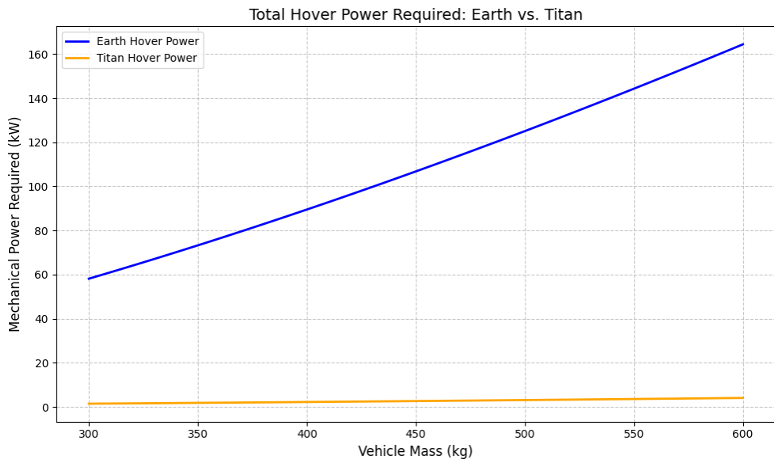
Total hover power required, Earth vs. Titan, across a range of vehicle masses - Earth's curve rises past 160 kW at 600 kg while Titan's stays under 5 kW across the same range
Why Bring In CFD
Momentum theory alone ignores the drag of the blades spinning themselves
The momentum theory result above is a genuinely useful first-order estimate, but it only captures induced power - the power needed to accelerate air downward and generate thrust. It ignores profile drag power: the power needed just to spin the blades themselves through the air, independent of the lift they produce. Total hover power is really Ptotal = Pdrag + Pinduced, and getting drag power requires actually resolving the flow around a real rotor blade cross-section - which is what the 2D airfoil CFD analysis was built to do, connecting Titan's atmospheric conditions, low gravity, and rotor geometry to a true total power estimate rather than an idealized lower bound. Getting this right matters beyond academic completeness: power availability directly limits Dragonfly's flight time, hop distance, battery sizing, and overall mission planning.
CFD Model Setup
2D airfoil CFD in Titan's cryogenic, compressible-at-the-rotor-tip atmosphere
A C-mesh was built around a representative rotor blade cross-section, with 100 divisions along the arc and 50 divisions along the straight edges, biased toward the airfoil surface. The mesh was refined near the leading edge, trailing edge, and wake specifically so drag would not be dominated by numerical error rather than real flow physics. Boundary conditions: a velocity inlet at 45 m/s with components set for each angle of attack tested, a pressure outlet at gauge pressure zero, and a no-slip wall on the airfoil surface itself.
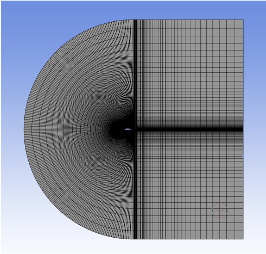
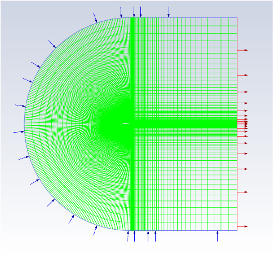
C-mesh refined at the leading edge, trailing edge, and wake (left) - boundary conditions: velocity inlet, pressure outlet, no-slip airfoil wall (right)
The 45 m/s inlet velocity isn't arbitrary - it's the representative blade velocity at the 70% radial station (r/R = 0.7), the standard reference point for characterizing rotor blade aerodynamics. With a rotor speed of 900 RPM and rotor radius R = 0.675 m, V = ωr = (2π · 900/60)(0.7 × 0.675 m) ≈ 45 m/s. Titan's atmosphere was modeled with dynamic viscosity μ = 6.5×10⁻⁶ Pa·s, specific heat 1040 J/(kg·K), thermal conductivity 0.009 W/(m·K), and molecular weight 27.4 kg/kmol, at a temperature of 94 K and operating pressure of 147 kPa.
Compressibility couldn't be ignored despite the modest 45 m/s freestream: Titan is extremely cold (~95 K), so the speed of sound there is only about 198 m/s - meaning 45 m/s already sits around Mach 0.23, and flow accelerating over the top of the airfoil locally exceeds Mach 0.3, the threshold where compressibility effects start to matter. Fluent was set up accordingly: pressure-based solver, steady, 2D, k-ω SST turbulence model, constant density, gravity off, energy equation on, and second-order upwind momentum discretization.
Results
Best lift-to-drag efficiency lands near 5 degrees angle of attack
| AoA | Cd | Cl | Drag | Lift | Cl/Cd |
|---|---|---|---|---|---|
| 0° | 0.0213 | 0.4398 | 10.93 N | 226 N | 20.65 |
| 5° | 0.0302 | 0.822 | 15.65 N | 423 N | 27.22 |
| 10° | 0.0712 | 0.9143 | 35.9 N | 471 N | 12.84 |
| 15° | 0.1431 | 0.9202 | 73.14 N | 474 N | 6.43 |
Cl rises steadily from 0° to 10-15° of angle of attack, but drag rises much faster at the higher angles - Cd nearly triples between 5° and 10° while lift barely increases. The best aerodynamic efficiency in this data set lands at 5°, where Cl/Cd peaks at 27.22 - this is the operating point used for the final power calculation below.
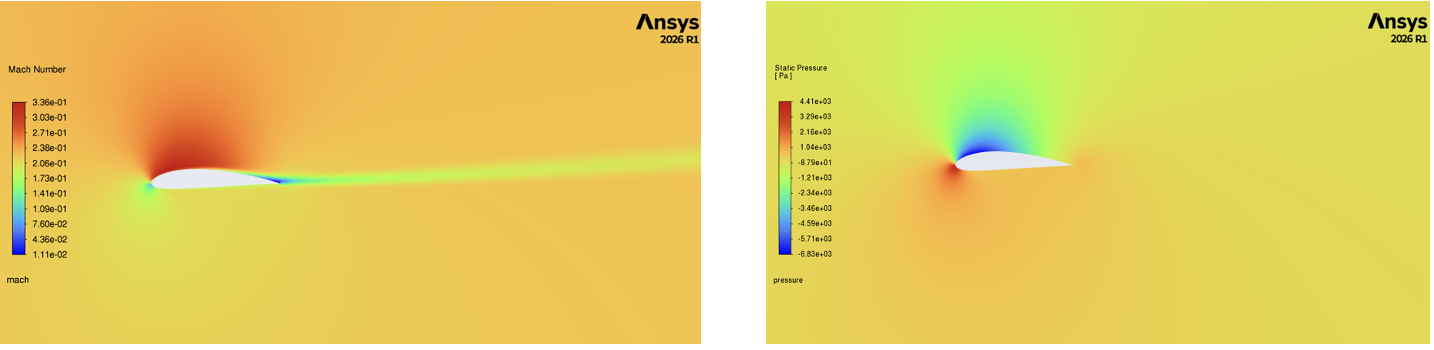
Mach number (top) and static pressure (bottom) contours at 5° angle of attack - flow accelerates and locally exceeds Mach 0.3 over the upper surface, confirming the need to model compressibility
Closing the Loop
Scaling the 5-degree CFD result up to the full 8-rotor vehicle
The CFD result is for one 2D airfoil section at one operating point - the last step is scaling it up to the real 8-rotor vehicle at its actual hover condition, using the 5° result as the reference since it's the most aerodynamically efficient point tested.
| Quantity | Expression | Value |
|---|---|---|
| Hover thrust | T = mg | 1,182 N |
| Total disk area | Atotal = 8πR² | 11.45 m² |
| Ideal induced power | Pideal = T3/2/√(2ρAtotal) | 2,374 W |
| Actual induced power | Pinduced = Pideal/FM, FM ≈ 0.75 | 3,165 W |
| Required lift per rotor | Lreq = T/8 | 147.7 N |
| Effective tip speed | Veff = 45·√(Lreq/LCFD) | 26.6 m/s |
| Scaled drag per rotor | Deff = DCFD·(Lreq/LCFD) | 5.47 N |
| Profile drag power (8 rotors) | Pdrag = 8·Deff·Veff | 1,164 W |
| Total hover power | Ptotal = Pinduced + Pdrag | 4,329 W |
Titan's thick atmosphere and low gravity mean Dragonfly only needs about 4.3 kW to hover - roughly the power draw of a residential central AC unit. The CFD-derived profile drag term accounts for about 25% of that total, which is exactly the piece the momentum-theory-only estimate misses. But 4.3 kW is still a substantial amount of continuous power for a deep-space probe - the MMRTG only generates about 100 W of continuous electrical power, more than an order of magnitude short of what's needed to fly. The direct mission-design consequence: Dragonfly cannot fly continuously. It has to sit and charge its battery for an extended period before each short flight - a "charge and hop" architecture dictated entirely by this power gap.