Objective
Solve a real problem: rolling a full-width Marley dance floor without strain or awkwardness.
Marley flooring - the standard black vinyl surface used in professional dance and performance spaces - is heavy, wide, and difficult to handle. Rolling it by hand typically requires multiple people and produces an uneven roll that is hard to store and damages the material over time.
The goal was a single-person operable device that rolls the Marley consistently and tightly, stores compactly in a vertical position, and can be moved freely around the stage space without lifting.
Design
Four components working together: frame, roller, crank, and casters.
The device is built around a plywood structural frame spanning the full width of the Marley floor. A Schedule 40 PVC pipe serves as the rolling mandrel - light enough to handle but stiff enough to maintain a consistent roll diameter. A crank mechanism on one end allows a single operator to wind the floor without bending or gripping the tube directly.
Four locking swivel casters allow the device to be pushed across the stage in any direction, then locked in place during rolling to prevent drift. The low profile of the caster mount allows the leading edge of the Marley to feed cleanly onto the PVC roller from the floor.
The frame's structural components and brackets were laser-cut from plywood for precise, repeatable geometry - important for keeping the roller aligned square across the full width of the device. The tube end caps and the crank handle itself were 3D-printed, letting both parts be shaped specifically for a secure, comfortable grip and a clean fit onto the PVC mandrel without needing separate off-the-shelf hardware.
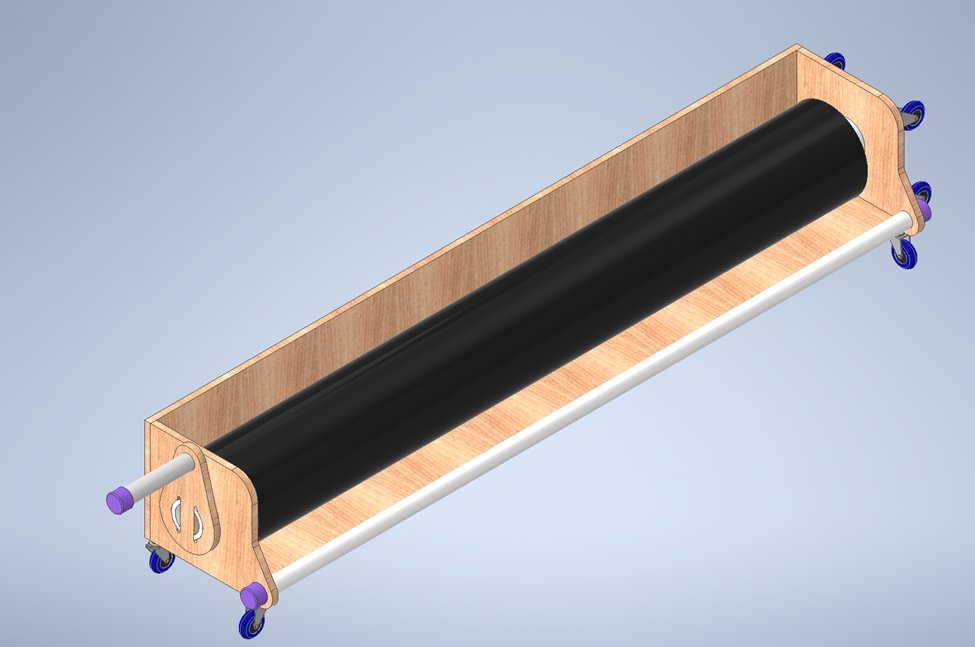
SolidWorks isometric CAD - frame, PVC roller, crank, and caster assembly
Physical Build
Deployed on a real stage. Tested under real conditions.
The device was fabricated and tested in the actual performance space it was designed for. During deployment testing, the roller successfully wound the full width of Marley floor to a tight, even roll - a significant improvement over manual handling. Caster selection proved to be the most consequential component decision: swivel locking casters allow free positioning during setup and solid locking during operation, which is critical for consistent roll quality.
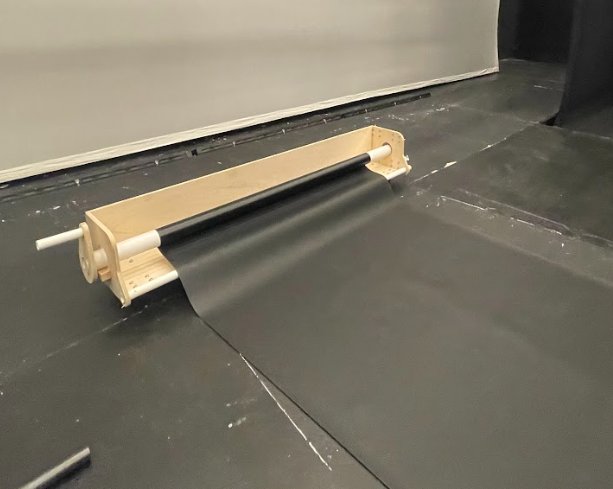
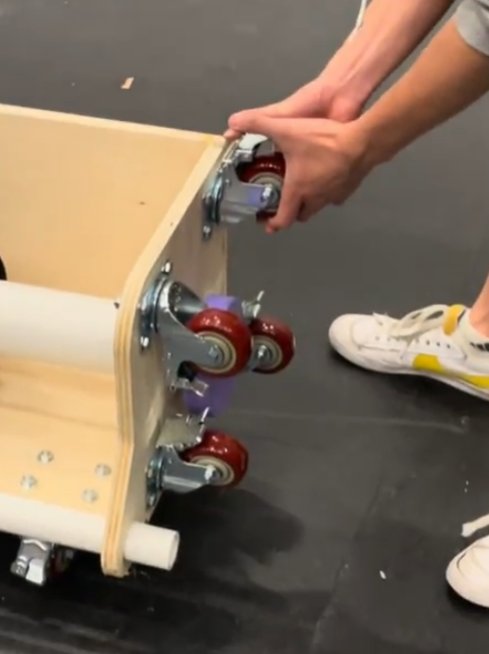
Roller deployed in the performance space, actively winding the Marley floor (left) · locking swivel casters - free movement and secure locking during operation (right)
Watch Demo